13 New Social Media Platforms You Should Know in 2026

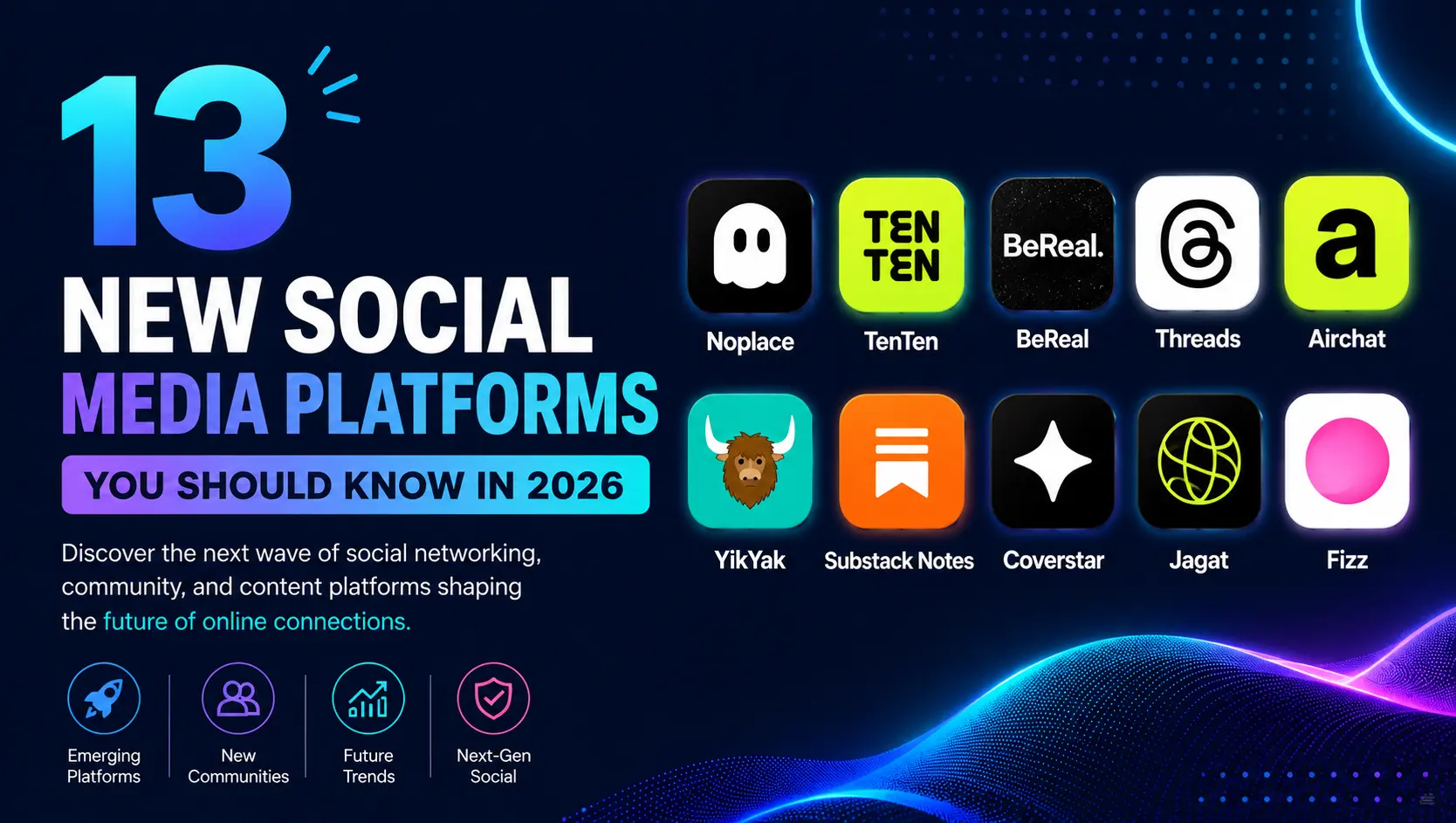
From Noplace to Bluesky, new social media platforms are shaping the future of how we connect online with each other. Social media continues to grow fast, with fresh platforms popping up that bring unique ideas to the table. From text-based content to real-time voice chats and location-based networking, these best new social media platforms are redefining how people, especially Gen Z and all ages, Kids, Youngsters, fathers, and Grandpa, communicate online.
Whether you are looking for the newest social media apps, upcoming social networking sites, or just curious about what is trending right now, here is a curated list of the best new social platforms gaining more attention in 2026.
Let’s explore one by one the new social media platforms 2026, and we are also offering a comprehensive shopify store development.
1. Noplace is the Top Of The New Social Media Platform
- The current website is thenoplace.com
- He was released in July 2024
- The current headquarters are in San Francisco, California
- No public data available on users
- Best for: Gen Z, people who want interest-based discovery, anyone tired of algorithm-heavy feeds
- Available: iOS (Android in development as of 2026)
- Funding is $19 million
Noplace is one of the newest social media platforms designed especially for Gen Z. It’s a mix of Twitter and Myspace, reimagined for today’s youth. The app is colourful, aligned with youngsters’ current choices, friendly for all ages, creative, and all about self-expression. Users can create their profiles, add tags in the body of content that reflect their interests, and directly link with others who share similar content. Noplace offers two features: a global feed where everyone sees the same content, and a friends-only feed tailored to your social circle. It’s one of the most interesting emerging social media platforms right now. RealDigitalEra is a US-based digital marketing agency and offers services globally seo for shopify bradford.
Who Uses Noplace?
Noplace’s core audience is Gen Z, specifically users in their teens and early twenties who grew up after the peak of Facebook and never really felt at home on Instagram’s polished, performative culture.
The platform appeals to people who want to:
- Express their identity beyond photos and videos
- Discover others with genuinely similar interests, not just mutual friends of friends
- Have a social media presence that feels personal rather than professional
- Connect casually without the pressure of follower counts and viral content
It’s also attracted people nostalgic for the early internet, the era when your profile said something real about who you were, not just what you looked like.
Key Features of Noplace
- Customizable profile colours and layout: You can make your profile distinctly yours visually — a small but meaningful departure from the identical white-background design language most platforms use.
- Interest-based profiles: You build your profile by rating and listing interests across categories, music, food, hobbies, and opinions. Your profile becomes a personality snapshot rather than a photo grid.
- Matching and discovery: Noplace surfaces other users based on shared interests, not just people you already know. This makes it genuinely useful for meeting new people online in a way most platforms stopped facilitating years ago.
- Status updates: Short, casual updates that sit at the top of your profile, more personal than a tweet, less polished than an Instagram story.
- Vibe-based feed: Your feed shows what people in your extended interest network are posting and feeling, not what an algorithm decided would keep you scrolling longest.
Noplace Pros and Cons
Pros:
- Genuinely different approach to social discovery
- Low-pressure environment — no follower counts front and center
- Strong community feel among early adopters
- iOS performance is smooth and well-designed
- Organic growth means the community is self-selected and engaged
Cons:
- Android version not available in all regions as of 2026
- Smaller user base than mainstream platforms, you may not find everyone you know
- Still adding features, some basic functionality (DMs, groups) is limited
- Relies heavily on you investing time in your profile to get value out of discovery
Should You Try Noplace?
If you’re a Gen Z user looking for something that feels less like a content consumption machine and more like an actual social experience — yes, absolutely worth trying. If you’re a marketer or brand trying to reach Gen Z audiences in an organic way, Noplace is worth monitoring closely, even if it’s too early for full campaigns.
2. TenTen is the Newest Social Media
- The newest social media apps that are currently on a website are tenten.app
- This was released in September 2022
- The headquarters is located in Paris, France
- Users have not disclosed right now
- Total funding $38.2 million
TenTen is a fun new social app specially created for teenagers. It’s a walkie-talkie-style platform where users can send voice messages to their best friends. Since the Android launch in January 2024, it has already crossed 10M+ downloads in a very short period of time. He is a great example of an up-and-coming social media app bringing voice communication back in style.
Key Features:
- Instant voice messaging (walkie-talkie style)
- “Poke” notifications to get a friend’s attention
- Optional video chat and silent/DND mode
- Messages are ephemeral (not stored) for privacy
3. BeReal
- The website is bereal.com
- He released 05 years ago in January 2020
- The headquarters is located in Paris, France
- Current users 25M right now
- Funding acquired
BeReal is a photo-sharing platform that promotes the authenticity of users. Once a day, users receive a random notification to snap a photo within 2 minutes using both the front and back cameras. It’s all about showing your real life, not curated moments. BeReal continues to be one of the best new social media apps with a solid young adult following. Recently, we have published a value-delivered-based blog post on automotive SEO and retail marketing.
Main Features:
- One post per day
- No filters or heavy editing
- Friends-focused feed instead of followers
- Reactions using “RealMoji” selfie reactions
4. Nieuw Social Media Platform Threads
- Website is www.threads.net
- He released in July 2023
- Headquarters located at Menlo Park, California, USA
- Users are 275 million
- Funding is Owned by Meta(Facebook, Instagram and WhatsApp)
He is directly linked with Instagram and works on Twitter, known as X and publishes posts on text-based, images and video content. You can write posts of 500 characters, which can be public or private. He is one of the most popular new social networking sites; it shows how major tech companies are still betting big on short-form text. Also, he is popular among politicians and in political parties, where they express what they want to share with their followers. One of the best guides for business growth is on Digital PR.
Main Features:
- Post text updates up to 500 characters
- Share photos, links, and videos (up to about 5 minutes)
- Like, reply, repost, and quote posts
- Automatically connect with people you follow on Instagram
- Following feed + recommended content feed
- Newer updates include direct messages and disappearing posts
5. Airchat is a New Social Media
- Website is www.air.chat
- He released in April 2024
- His headquarters is located in Los Angeles, California, USA
- Users are not disclosed right now
- Funding has been undisclosed till now
Airchat is a voice recorder platform where users can record short audio messages and then send them to their friends. It’s a mixture of both Twitter(known as X) and Clubhouse, making it one of the most unique emerging social platforms of the year. The feed blends voice and text to create a more natural, spoken form of social networking.
How Does It Work?
- You open the app and scroll a feed of voice posts similar to Twitter/X.
- Tap the microphone icon and speak to create a post.
- Other users can listen, reply with their own voice message, like, or share.
- The audio automatically plays like a podcast feed while scrolling.
Key Features:
- Voice-based social posting
- Automatic speech-to-text transcription
- Follow users and topic channels
- Private voice messaging
- Sometimes, invite-only access in early stages
6. YikYak
- New social media platform website: www.yikyak.com
- The release date is August 2021
- Headquarters located in the USA
- Users are not publicly shared
- Funding is $75 million
Another new social media site includes YikYak. He is a pseudonymous social network that lets users post updates to others nearby, within a 5-mile radius. Popular on the college’s campuses, it’s effective for the local community to update and anonymously share. With over 3.5 million iOS downloads right now, it’s definitely a new social media site worth checking out.
How Does It Work?
- Posts are shown to people within a nearby geographic area (for example, people in the same school, college, or neighbourhood).
- Other users can upvote or downvote posts.
- Popular posts appear higher in the local feed.
- If a post gets many downvotes, it may disappear.
Key Features:
- Anonymous posting
- Local community feed
- Upvote/downvote system
- Comment replies under each Yak
- Safety moderation tools to report harmful posts
7. Substack Notes
- The official website is www.substack.com/notes
- He released in April 2023
- The headquarters is located in San Francisco, California, USA
- The number of users is not disclosed
- Funding is $89.4 million
Latest social media apps that are built on top of Substack’s newsletter platform, He allows content creators and readers to share limited-character posts in X(formerly known as Twitter) format. It’s a useful site for helpful content writers who want to build an audience beyond just newsletters, and it’s gaining traction as a new social platform for thought leadership and discussion.
How Does It Work?
- A creator writes posts (articles, opinions, stories, or lessons).
- Followers subscribe using email to receive posts automatically.
Writers Can Offer:
- Free subscriptions
- Paid subscriptions (monthly or yearly)
Key Features:
- Newsletter publishing
- Blog-style posts with comments
- Paid membership system for creators
- Podcasts and audio posts
- Reader communities and discussion threads
8. Coverstar
- The website is www.coverstar.app
- He was officially launched in March 2017, and around 8 years have passed.
- Headquarters at Berkeley, California, USA
- Users are not disclosed right now
- Funding has Undisclosed
New social media apps, including the Coverstar brand itself as a safe TikTok alternative, focus on content moderation and user safety. With no direct messaging to other platform members and strict rules against harmful content, it’s ideal for young users or parents who are looking for a kid-friendly new social media app.
Main Features:
- Create and upload short videos, dances, vlogs, and reactions
- Like, comment, and follow other creators
- Participate in video challenges and trending prompts
- Custom avatars for profiles and creative content
- Livestreaming available for approved creators
- No direct messaging to reduce unwanted contact
Safety Approach:
- Posts are reviewed with AI + human moderation
- Strict rules banning adult or harmful content
- Reporting and blocking tools for safety
9. Jagat
- The official site is jagat.io
- Released in March 2023
- This site’s headquarters is located in Singapore, outside the USA
- Showing current users 10M plus
- Funding still not disclosed
New social sites like Jagat are location-based social media apps like Google Maps, with a real-time map that shows where your friends are available right now and what they’re up to. Gen Z makes up 85% of its user base, and the platform is designed to help people meet without any problem, hang out, and discover local events. It’s a fast-growing social media platform for youngsters that connects the digital and physical worlds.
How Does It Work?
- You add friends inside the app.
- With permission, they can see your live location on a map.
- You can also:
- Chat with friends
- Send reactions or messages
- Check where friends are hanging out
Main Features:
- Real-time location tracking
- Friends-only private map
- Chat and interaction features
- Optional visibility controls (you can hide the location anytime)
Safety Tip (Important):
Because the app shares live location, it is safest to:
- Share location only with people you trust
- Turn off location when not needed
- Regularly check your privacy settings
10. Fizz
- Official site is www.fizzsocial.app
- Released 4 years ago in January 2021
- Headquarters is in Palo Alto, California, US
- Officially, users have not disclosed
- Funding is $41.5M
Fizz is an anonymous social network, especially helpful for college students, offering private communities on each college campus. Besides social posts, Fizz features an in-app marketplace to buy and sell between students. It’s one of the emerging newest social platforms, combining social interaction with practical use.
How Does It Work?
- Students join using their school or university email.
- They can post messages, memes, polls, or questions without showing their name.
- Other students can react, comment, and vote on posts.
Main Features:
- Anonymous posting
- Campus-only community feed
- Polls, memes, and discussions
- Upvote/downvote reactions
- Moderation tools for safety
11. Lemon8
- It’s an official site URL: www.lemon8-app.com
- He released in March 2020
- The current headquarters is located in one of the top business countries, Singapore
- The company has not shared users’ data
- Funding owned by ByteDance
Latest social media lemon8 is a mixer of both Instagram and Pinterest, where users can share their daily life activities. You can see the popularity of this app is 18.7M downloads in 2024, it allows users to post their photo or video-based content, share beauty tips, and vlogs related to travel. It’s one of the best market new social apps for healthy content creators and visual storytellers.
How Does It Work?
- Users create photo-based posts with captions, tips, or step-by-step guides.
- People can like, save, comment, and follow creators.
- Content is organized into categories like fashion, skincare, study tips, travel, fitness, and food.
Main Features:
- Aesthetic photo posts and carousels
- Lifestyle tips and tutorials
- Search and category-based discovery
- Save collections for inspiration
- Creator-focused growth tools
12. Lapse
- Website is www.lapse.com
- Released in July 2022
- The headquarters is located in London, United Kingdom
- The current users are not disclosed
- Funding is $42.4M
Lapse brings back the fun of disposable cameras. Take a photo, wait a few hours for it to develop automatically and share it later. It’s private and great for daily base memory-making. Available on the Play Store with 10M+ downloads in 2026, Lapse is a new social media platform that’s quietly gaining traction.
How Does It Work?
- You take photos inside the app using the Lapse camera.
- Photos are not visible immediately; they appear later after a “developing” process.
- Once developed, pictures are shared with friends in private feeds, not public followers.
Main Features:
- Disposable-camera style photography
- Delayed photo reveal (“develop later”)
- Friends-only sharing
- No heavy editing filters
- Albums and memories collection
13. Bluesky
- The official website is www.bsky.app
- Released in February 2023
- The current headquarters is located in Seattle, Washington, USA
- Users are 25M+
- Funding is $23 million
- Downloads are 10M+
He is an independent and is working as a replacement for Twitter(Known as X). Fewer than 300 characters are posted per limit, and the ability to post photos, videos, etc. One of the unique new+social+media+platforms features allows users to directly control their online identity in the best manner. If you’re asking, What is the newest social media platform? Bluesky is one of the best examples for you. In short, Bluesky = Twitter-like social network + more user control + decentralized system.
New Social Media Platforms Compared: Which One Is Right for You?
There’s no single “best” new social media platform. The right choice depends entirely on what you’re looking for, whether that’s building an audience, staying in touch with friends, exploring creative content, or just getting away from the noise of the major apps.
This comparison table covers all the major new platforms so you can match each one to your actual needs.
Full Comparison: New Social Media Platforms 2026
| Platform | Launched | Est. Users | Best For | Content Type | Age Group |
| Threads | 2023 | 275M | Twitter alternative, casual updates | Text, images, video | All ages |
| Bluesky | 2023 | 30M+ | Open, ad-free social networking | Text, images | 20–40 |
| Noplace | 2024 | Growing | Gen Z self-expression | Text, profile customisation | 16–25 |
| TenTen | 2022 | 10M+ | Teen voice messaging | Voice notes (ephemeral) | 13–20 |
| BeReal | 2020 | 25M | Authentic daily photo sharing | Photos (no filters) | 18–30 |
| Substack Notes | 2023 | N/A | Writers, newsletters, thought leadership | Text, links, audio | 25–45 |
| Airchat | 2024 | N/A | Voice-first conversations | Voice + auto-text | 20–35 |
| YikYak | 2021 | N/A | Anonymous local community | Text (anonymous) | 18–25 |
| Lemon8 | 2023 (US) | Growing | Lifestyle content, aesthetics | Photos + long captions | 18–30 |
| Coverstar | 2017 | N/A | Safe TikTok alternative for kids | Short video | Under 18 |
New Social Media Platforms for Adults: Beyond Instagram and TikTok
Most social media coverage focuses on what teenagers are using. But adults — particularly those in their late 20s, 30s, and 40s — have their own set of frustrations with existing platforms. Too much noise and too many ads. Too much pressure to perform. Algorithm feeds that bury what you actually want to see.
If you’re an adult looking for social media that doesn’t feel like a second job, here are the platforms actually worth your time.
What Do Adults Actually Want from Social Media?
Before recommending platforms, it’s worth being honest about what adults tend to need differently from teenagers:
- Less noise, more signal: Quality over volume
- Professional or intellectual value: Not just entertainment
- Genuine connection: Not follower counts or vanity metrics
- Privacy controls that actually work: Real options, not buried settings
- No pressure to post constantly: Engagement at your own pace
- Monetisation options for creating content professionally
With those needs in mind, here are the strongest options.
1. Bluesky — For Adults Who Miss What Twitter Used to Be
Bluesky is probably the best social media platform for adults right now who want open, intelligent conversation without the toxicity that X has accumulated.
Why adults choose it:
- Chronological feed means you see what you chose to follow, in order
- No advertising (currently) means no one is optimizing for your outrage
- The community skews toward journalists, academics, researchers, and professionals
- Block and moderation tools are significantly more effective than X’s
Best for: Professionals, writers, researchers, and anyone who used Twitter for news and ideas before it became unpleasant.
2. Substack Notes — For Adults Who Think in Paragraphs
Substack Notes is the cleanest space for intelligent long-form and short-form content — if that sounds contradictory, think of it as Twitter for people who know how to finish a thought.
Why adults choose it:
- Built-in monetization if you want to turn your writing into a newsletter
- The audience is actively seeking ideas, not just scrolling to pass the time
- No engagement-bait algorithm pushing controversy
- Direct email connection to readers who actually want to hear from you
Best for: Writers, educators, consultants, coaches, and independent thinkers building an audience.
3. Airchat — For Adults Who Communicate Better by Speaking
Airchat is for adults who have things to say but find text-based social media reductive. You record a voice post, your actual voice, with your actual tone, and it plays in a scrollable feed with auto-transcription.
Why adults choose it:
- Voice communication is naturally more nuanced than text
- The format slows conversation down in a useful way — you have to think before you speak
- The current community is small but exceptionally high quality
- Less performative than video content (no camera anxiety)
Best for: Professionals, consultants, thought leaders, and podcasters looking for a social extension of their audio content.
4. Mastodon — For Adults Who Want Full Control
Mastodon is the fully decentralised option. There’s no single company running it. You choose a server (called an instance) based on your interests or community, and you’re part of a federated network that connects all instances.
Why adults choose it:
- No ads. Ever. The platform is community-run and nonprofit-oriented.
- Your data doesn’t belong to a corporation
- You can move your account between servers without losing followers
- Multiple instances cater to specific interests — technology, journalism, art, science
Honest caveat: The setup process is less intuitive than mainstream apps. If you’re comfortable with a bit of initial friction, the long-term experience is genuinely better. If you just want to scroll immediately, start with Bluesky instead.
Best for: Privacy-conscious adults, tech-savvy users, journalists, academics, and anyone who wants the antithesis of Facebook.
5. BeReal — For Adults Tired of Curated Perfection
BeReal sends a random notification once per day. You have two minutes to take a photo. Front and back camera, simultaneously. No filter. No staging. That’s your post.
Why adults choose it:
- Removes the pressure of a perfectly curated feed
- The format itself prevents social comparison spirals — nobody looks perfect on BeReal
- Friends-focused rather than follower-count obsessed
- Time-limited daily interaction — you don’t have to be on it constantly
Best for: Adults who want a lightweight, low-pressure way to stay connected with actual friends rather than building a public audience.
6. LinkedIn (with realistic expectations)
LinkedIn isn’t new, but it’s worth including because adults often overlook how much the platform has evolved. The engagement quality has gone down, but for B2B professionals, consultants, agency owners, and freelancers, it still has no real alternative for professional audience-building.
The honest reality: LinkedIn’s feed is noisy and increasingly performative. But the professional targeting, the direct message credibility, and the SEO value of a LinkedIn company page or personal profile still make it the most commercially useful platform for professionals.
Best for: B2B service providers, consultants, agency owners, recruiters, and corporate professionals.
Quick Guide: Best New Social Media Platforms for Adults by Goal
| Goal | Best Platform | Why |
| Intelligent conversation | Bluesky | Chronological, no ads, high-quality users |
| Building a writing audience | Substack Notes | Direct email list + short-form social combined |
| Audio/voice presence | Airchat | Voice posts, auto-transcribed, engaged early community |
| Full privacy and control | Mastodon | Decentralised, no corporate ownership |
| Staying in touch with friends (low pressure) | BeReal | Once daily, no algorithm, no follower counts |
| Professional networking | Still unmatched for B2B reach |
What Adults Should Avoid Right Now?
TikTok: Not because of the content, but because the time-per-session is algorithmically optimised in a way that works against deliberate, intentional use. If you’re building content professionally, TikTok has reach. If you’re using it casually, the average session length data is genuinely concerning.
Facebook: If you’re not using it specifically to stay connected with older family members or run business ads, there are better options for every other use case.
Instagram: Still valuable for visual brand-building, but the organic reach for regular users has declined significantly. Unless you’re a visual creator with a posting strategy, the effort-to-value ratio has dropped.
The best social media strategy for most adults in 2026 is actually simpler than it sounds: pick one platform that serves your main goal, show up there consistently, and ignore the rest.
New Social Media Apps Compared by Use Case
If you want a Twitter alternative: → Bluesky for an open, chronological, ad-free experience → Threads for the easiest transition with the biggest existing user base → Mastodon for maximum control and community ownership.
Also, if you want something for teenagers: → TenTen for voice-first, low-pressure communication → Noplace for self-expression and interest-based connection → Coverstar for parents who want a moderated, safe environment
If you want something for creators and professionals: → Substack Notes for writing and building a newsletter audience → Airchat for voice-based thought leadership → Bluesky for joining an intellectually engaged community
And if you want authentic, non-curated content: → BeReal for one honest photo per day, no filters → Noplace for personality over performance → YikYak for anonymous, unfiltered local conversation
If you’re in fashion, food, travel, or beauty: → Lemon8 for long-form aesthetic content that Pinterest users will recognise
New Social Media Platforms vs. Old Platforms: Key Differences
The older platforms, Facebook, Instagram, Twitter, and Snapchat, were built for mass scale. The newer ones are generally built around a specific philosophy or audience. Here’s how the philosophies differ:
| Old Platform | What It Got Wrong | New Alternative | What It Does Better |
| Twitter/X | Algorithm manipulation, ads everywhere | Bluesky | Chronological feed, open protocol |
| Pressure to look perfect | BeReal | One unfiltered photo per day | |
| Declining younger audience | Noplace | Built for Gen Z from the ground up | |
| Snapchat | Became cluttered with features | TenTen | One thing done well: voice messages |
| Performative professionalism | Substack Notes | Real writing, real ideas |
Which Platform Should You Join in 2026?
Here’s the honest answer: you don’t need to be on all of them.
Pick based on your actual goal:
- Building an audience as a creator? Start with Bluesky and Substack Notes. These have the highest concentration of engaged, early-adopter audiences right now.
- Keeping up with trends for marketing? Watch TenTen and Noplace — they show where Gen Z attention is heading next.
- Personal use and genuine connection? BeReal and Noplace are the least algorithmically manipulative options available right now.
- Professional networking alternative to LinkedIn? Substack Notes, with Airchat as a secondary.
The platforms that win long-term aren’t the ones with the most users. They’re the ones where the users who are there actually want to be there.
New Social Media Platforms by Year: From 2020 to 2026
Social media doesn’t stand still. Every year brings a fresh wave of apps, each one trying to solve something the old platforms got wrong — too much noise, too many ads, not enough real connection. Here’s a year-by-year breakdown of the most notable platforms that launched or broke through in each period, so you can see exactly how the landscape has evolved.
New Social Media Platforms 2020
2020 was a turning point. With people stuck indoors, social apps exploded in popularity, and several new faces entered the scene.
| Platform | Type | What Made It Different |
| BeReal | Photo sharing | Random daily notifications, no filters, front and back cameras simultaneously |
| Clubhouse | Audio/voice | Live audio rooms, with invite-only access, created massive buzz |
| Dispo | Photo sharing | Live audio rooms, with invite-only access created massive buzz |
Why 2020 mattered: It proved that people were hungry for authenticity. BeReal launched directly challenging Instagram’s polished culture, and Clubhouse showed that audio-only communities had real demand.
New Social Media Platforms 2021
2021 was the year short-form video became the default format everywhere.
| Platform | Type | What Made It Different |
| YikYak (Relaunch) | Anonymous local | Neighbourhood-based anonymous posts, revived after original shutdown |
| Twitter Spaces | Audio rooms | Twitter’s answer to Clubhouse, built directly into the existing app |
| Tumblr (Revival) | Blogging/community | Returned with new ownership and a renewed younger audience |
Why 2021 mattered: Anonymity made a comeback. YikYak proved that hyperlocal communities still had strong appeal, especially on college campuses.
New Social Media Platforms 2022
Platform competition heated up, with creators demanding better monetisation tools.
| Platform | Type | What Made It Different |
| TenTen | Voice messaging | Walkie-talkie style audio for teens, ephemeral messages |
| Mastodon (mainstream growth) | Decentralised | Fed up with Twitter’s direction, many users migrated to open-source alternatives |
| Lemon8 | Lifestyle/discovery | ByteDance’s answer to Pinterest, heavy on aesthetic content |
Why 2022 mattered: Decentralisation began to enter the mainstream conversation. Users began questioning who actually controls their data and feeds.
New Social Media Platforms 2023
2023 was defined by one word: fragmentation. Twitter’s turbulence pushed millions toward alternatives.
| Platform | Type | What Made It Different |
| Threads | Text-based | Meta’s direct Twitter competitor, reached 100M users in under a week |
| Bluesky | Decentralised text | Jack Dorsey’s open-protocol social network, invite-only at launch |
| Substack Notes | Writer-focused | Short-form posts layered on top of Substack’s newsletter platform |
Why 2023 mattered: It was the biggest shakeup in social media since Facebook went public. The search for a “Twitter alternative” went from niche to mainstream almost overnight.
New Social Media Platforms 2024
2024 brought voice back and made Gen Z the dominant audience to design for.
| Platform | Type | What Made It Different |
| Noplace | Gen Z social | Twitter meets Myspace, colourful profiles and global feeds, no follower counts |
| Airchat | Voice-first | Audio posts with auto-transcription, blending podcasts and social feeds |
| Bluesky (public launch) | Decentralised | Opened to everyone without invites, reached 20M+ users rapidly |
Why 2024 mattered: Voice and audio formats proved they aren’t a trend, they’re a genuine behavioural shift, especially among younger users who prefer speaking over typing.
New Social Media Platforms 2025
2025 saw AI-native features become a baseline expectation rather than a bonus.
| Platform | Type | What Made It Different |
| Bluesky (growth phase) | Decentralised | Passed 30M users, became a genuine mainstream alternative |
| Threads (matured) | Text-based | Added direct messages, better algorithm controls, long-form support |
| AI-integrated feeds | Various | Multiple platforms rolled out AI-suggested content, AI chat within feeds |
Why 2025 mattered: The gap between traditional social media and AI-powered tools began to close. Users began expecting their platforms to understand context, not just show the latest post.
New Social Media Platforms 2026
2026 is shaping up to be the year decentralised and niche platforms challenge the big five seriously.
| Platform | Type | What Made It Different |
| Noplace | Gen Z | Expanding features, growing creator tools |
| TenTen | Teen voice | 10M+ downloads, pushing toward Android globally |
| Bluesky | Open social web | Continuing to build the AT Protocol ecosystem |
| Emerging AI platforms | AI-native | New apps built from scratch with AI conversation at the core |
The 2026 trend to watch: Platforms that give users actual control of their data, their algorithm, and their experience are pulling ahead of those that don’t.
Trending and Emerging Social Media Platforms to Watch Right Now
Not every platform makes the headlines immediately. Some build slowly, gain a loyal core audience, and then suddenly break through. Others spike fast and fade. Knowing the difference is what separates a smart early adopter from someone chasing the wrong wave.
Here’s a breakdown of the social platforms currently gaining the most momentum, and what’s actually driving their growth.
What Makes a Social Media Platform “Trending”?
A trending social media platform isn’t just one with a lot of users. It’s one where active engagement is growing, not just total signups. The real signals to watch are:
- Monthly active user growth month over month, not just total numbers
- App Store ranking consistency over 30–90 days
- Creator migration: When content creators move to a platform, audiences follow
- Press and word-of-mouth coverage without paid promotion
- Retention rate: Are new users coming back after the first week?
By these measures, here are the platforms genuinely trending right now.
1. Bluesky — The Rising Alternative to X
Bluesky isn’t new, but it’s in a genuine growth phase that many newer apps haven’t reached. It’s built on an open protocol called AT Protocol, meaning no single company owns the network.
- Journalists, academics, and creators are migrating from X at an accelerating pace
- No algorithm manipulation — the feed is chronological by default
- Users can actually move their account and followers to a different server if they don’t like the platform’s direction
- Reached 30M+ users without any major advertising campaign
Why it’s rising:
Who it’s for: People who miss what Twitter felt like in 2012–2016. Writers. Researchers. Anyone frustrated with feed manipulation.
2. Noplace — The Fastest Rising Gen Z Platform
Noplace reached viral status in mid-2024 and has been building steadily since. It’s not trying to be TikTok. It’s closer to a reimagined MySpace — personal profiles, interest tags, a global feed where anyone can discover anyone.
Why it’s rising:
- Gen Z is tired of Instagram’s polished aesthetic and TikTok’s pure entertainment loop
- Noplace is explicitly built around personality and interests, not follower counts
- The colourful, customisable profile design creates a sense of ownership that younger users love
- Strong word-of-mouth growth — no major ad spend
Who it’s for: Anyone under 25 who wants an online identity to feel personal again, not performative.
3. TenTen — The Up-and-Coming Voice App for Teens
TenTen launched in 2022 but crossed 10 million downloads after its Android release in early 2024. It’s described as a walkie-talkie app — you hold a button and speak, and your friend receives it like a voice note that plays instantly.
Why it’s rising:
- Teens are over texting but not ready for full video calls — voice hits a middle ground
- Ephemeral messaging (messages disappear) removes the pressure of a permanent record
- Simple, low-friction design that adults can barely figure out — which is exactly what teenagers want
- Funded at $38.2M, which means serious product development is coming
Who it’s for: Teens and young adults who communicate better verbally than in text.
4. Substack Notes — The Rising Platform for Writers and Thinkers
Substack Notes is often overlooked because it’s an add-on to Substack’s newsletter product. But it functions as a completely standalone microblogging feed, similar to Twitter, but populated almost entirely by writers, journalists, researchers, and independent creators.
Why it’s rising:
- The feed is not algorithmic in the same manipulative way as X or LinkedIn
- Writers who have already built newsletter audiences are now extending into short-form with built-in distribution
- Genuinely high-quality conversations — less noise than most mainstream platforms
- Funded at $89.4M, with the parent company focused on creator monetization
Who it’s for: Readers and writers. Anyone who prefers substance over virality.
5. Airchat — The Emerging Voice-First Social Network
Airchat is genuinely unlike anything at scale right now. It’s a social media feed where posts are voice recordings, automatically transcribed into text. You scroll like Twitter, but instead of reading, you’re listening.
Why it’s rising:
- The format is completely different; there’s no equivalent at any major platform
- Auto-transcription means even people who prefer reading can still participate
- Early community is intellectual and high-quality, similar to early Twitter’s best days
- Voice naturally filters out the lazy engagement patterns that kill content quality on text platforms
Who it’s for: Creators, thinkers, podcasters, and anyone who communicates more naturally by speaking than typing.
6. Lemon8 — The Quietly Growing Lifestyle Platform
Lemon8 doesn’t get the headlines, but it’s been growing steadily as a lifestyle and aesthetic content platform. Think Pinterest meets Instagram, built by ByteDance (TikTok’s parent company).
Why it’s rising:
- Strong in fashion, food, travel, beauty — highly visual niches
- Longer-form photo posts with text feel closer to a magazine than a social feed
- Users are creating serious, well-researched content rather than quick takes
- ByteDance’s distribution infrastructure gives it a built-in growth advantage
Who it’s for: Lifestyle creators, bloggers, and anyone in fashion, food, beauty, or travel niches.
Trending vs. Established: A Quick Comparison
| Platform | Stage | Growth Direction | Best Use |
| Bluesky | Growing fast | ↑↑ Accelerating | Text/conversation |
| Noplace | Early growth | ↑↑ Strong | Gen Z identity |
| TenTen | Growth phase | ↑ Steady | Teen voice messaging |
| Substack Notes | Maturing | ↑ Steady | Writing/reading |
| Airchat | Early | ↑ Growing | Voice-first content |
| Lemon8 | Building | ↑ Quiet growth | Lifestyle content |
| Clubhouse | Declining | ↓ Fading | Audio rooms |
| BeReal | Stable | → Flat | Authentic photos |
What’s the Next Big Social Media Platform?
Honestly, the next truly massive platform probably isn’t one of the ones above. History shows that the biggest social media shifts come from formats nobody predicted: Snapchat’s disappearing messages, TikTok’s scroll-optimized video feed, Clubhouse’s audio rooms.
The signals worth watching right now are:
- AI-native platforms where content is generated and curated by AI in real time
- Spatial computing is tied to AR glasses and headsets
- Decentralised social is expanding beyond the tech-savvy early adopter crowd
The platforms that eventually dominate aren’t always the ones that look impressive on launch day. They’re the ones that solve a real communication need that existing platforms quietly ignore.
FAQs
What is the newest social media platform in 2026?
The newest social media platforms gaining attention in 2026 include Noplace, TenTen, and the continued growth of Bluesky. Noplace is designed specifically for Gen Z with colourful, expressive profiles and a global feed. TenTen brings back walkie-talkie-style voice messaging for teens. Bluesky, the decentralised platform built on the AT Protocol, has grown past 30 million users and positions itself as the most serious alternative to X (formerly Twitter).
What is the next big social media platform?
Based on current growth trends, Bluesky and Noplace are the most likely candidates for mainstream breakout in 2026–2027. Bluesky has the backing of strong ideological momentum around open, decentralised social media. Noplace is attracting Gen Z users who find Instagram and TikTok too commercially driven. Platforms built around voice-first interaction, like Airchat and TenTen, are also worth watching as a generation that prefers speaking over typing comes of age.
What are the best new social media apps for adults?
Adults looking for alternatives to mainstream platforms have strong options right now. Substack Notes is ideal for professionals and thought leaders who want to build an audience through writing. Bluesky suits those who want a Twitter-like experience without the algorithm manipulation. Airchat works well for people who prefer audio conversations over text. Mastodon is a good fit for anyone who wants full control over their social feed with no corporate advertising.
What new social media apps are similar to Twitter?
Several platforms were built directly as Twitter alternatives:
- Threads (by Meta): The closest in layout and function, now at 275M+ users
- Bluesky: Decentralised, chronological feed, no ads, open-source protocol
- Mastodon: Community-run servers, fully open source
- Substack Notes: Text-first, focused on writers and newsletters
- Airchat: Similar scrollable feed but with voice posts instead of text
Each one takes a different philosophy. If you just want something familiar, Threads is the easiest transition. If you want something with more control and fewer algorithms, Bluesky is the better long-term choice.
What are the most popular new social media platforms right now?
By active users and growth rate in 2026, the most popular newer platforms are:
- Threads: 275 million users, backed by Meta’s infrastructure
- Bluesky: 30M+ users and growing month over month
- TenTen: 10M+ downloads, fastest growing teen app
- Noplace: Rapidly growing Gen Z audience, primarily iOS
- Substack Notes: Strong among writers, journalists, and creators
These numbers shift regularly. Threads leads purely on scale, but Bluesky leads on engagement quality and user trust scores in independent surveys.
Are there new social media platforms made specifically for teenagers?
Yes, several newer platforms target teens directly. TenTen uses a walkie-talkie voice format that feels more casual and immediate than text. Noplace is built around self-expression and connecting over shared interests, with no follower counts to create pressure. Coverstar was designed as a safe TikTok alternative with strict content moderation and no direct messaging. YikYak is popular on school and college campuses for its anonymous, location-based posts. If safety is a priority, Coverstar and Noplace are the most moderated options in this group.
What are emerging social media platforms to watch in 2026?
The platforms showing the strongest early-stage growth signals in 2026 are:
- Noplace: Decentralised profile design, gaining ground fast with under-25 audiences
- Airchat: Voice-first posting is genuinely different from any major platform currently
- Bluesky: The AT Protocol is built on could power an entire ecosystem of apps
- Lemon8: ByteDance’s lifestyle platform quietly building a loyal content creator base
- Substack Notes: Slowly becoming the go-to space for independent writers and journalists
“Emerging” doesn’t always mean brand new. Some of these launched a year or two ago but are entering their real growth phase now.
What is the hottest social media app right now?
In mid-2026, TenTen and Noplace are generating the most conversation among younger users. TenTen crossed 10 million downloads after launching on Android in early 2024 and has continued growing steadily. Noplace regularly trends in app store rankings among Gen Z audiences in the United States. Among slightly older demographics, Bluesky is seeing the most active discussion, particularly among journalists, developers, and creators who have moved away from X.